
Y2 What Now?
Naming something can give it power, but is that a good thing?

Hi! This is where Jeanine and I share tips from the Design Career Handbook to help you chart and navigate a successful career path. I also share perspectives on what’s happening in technology and design. If you’re looking for assistance on your journey, you can book a session on ADPList, or we can discuss 1:1 coaching. - Kevin F
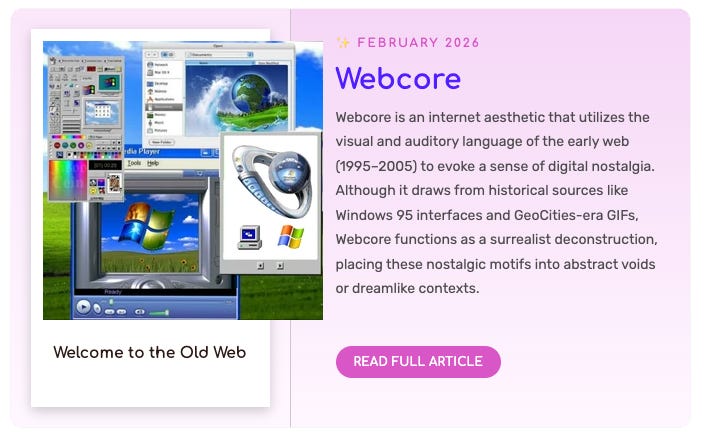
A coaching client recently shared another designer’s portfolio and asked for my opinion on its design. I immediately categorized it as “retro.” That was due to its minimalist 80s or early 90s user interface aesthetic, although it layered an e-ink look with justified text in a pixel font and a gray color palette. While I rolled my eyes a bit, I told my client that, even though I wasn’t excited about the portfolio’s style and disregard for readability, it stood out, and I would probably reach out to the designer to learn more about their actual case studies. For that reason alone, I deemed its design successful.
Now I’m as nostalgic as the next person, maybe even more so. Nostalgia hits everyone at different life stages, whether we’re trying to recapture something from our past or embrace something we missed out on. I’m a fan of either catalyst. In the past handful of years, I’ve noticed music from my generation popping up in commercials for cars, medications, insurance, you name it. Visual design-wise, I’ve seen a lot of hand-drawn lettering and letterpress-style graphics marked by telltale imperfections. I haven’t gotten tired of these styles because they evoke a non-digital making process. However, trends are fickle. It is possible to have too much of a good thing.
Meanwhile, I’ve also seen a rise in retro portfolios over the past five years or more. For a minute, I swear I heard designers online calling it brutalist. The Brutalist movement is best characterized by architectural choices from the 1950s to the 1970s. It reflected harsher geometric shapes and exposed materials like pipes and concrete. In terms of intent, it was about revealing structure, being honest and truthful, and favoring functionality over conventional aesthetics. From a digital design standpoint, the bold, oftentimes jarring anti-design movement in early 1990s web design could be seen as a spiritual offspring. That’s why I thought the terms neo-brutalism or neubrutalism might catch on.
It’s not at all surprising to me that younger designers who grew up with digital screens and video gaming platforms are drawn to pixel UI and early computer and internet interfaces. In an obvious way, their upward trend reflects another anti-design movement that rejects today’s flat, minimalist, over-polished interfaces; the sameness of software, mobile, and major website and app services.
In a random encounter, I sat next to a guy at a neighborhood coffee shop yesterday. We laughed at the serendipity that he was a 24-year-old industrial designer. (That itself supports my recommendation to get out of the house and network.) After introductory chit-chat, I asked for his thoughts on the retro design trend.
He said, “You mean Y2K?”
“Uh, maybe? I’m talking about pixel UI and early computer interfaces and stuff.”
“Yeah, I love it!”
“What do you love about it?”
“I don’t know. I like video games and Nintendo.”
That checked out. But I wanted to know more. In my head, I was thinking about the traditional design maxim, “You have to know the rules so you can break them.”
“What’s good about it?” I asked.
He thought for a moment, then gave an unexpected response, “I don’t know. But I do wonder what those designers in the 90s and 2000s were thinking when they did that style.” He added, “I guess that included you!”
As much as I wanted to take that last comment as a prompt, I was okay with us shifting topics. Before we moved on, he offered this opinion: “I expect designers are already moving into 2010s aesthetics, though...” I thought, “There’s a 2010s aesthetic?!” We pivoted to discuss how there’s a sameness in automotive design and that it was a shame some cars have lost their iconic styling. (I’m looking at you, Ford Mustang!)
Overall, his comments gave me hope. There must be young designers who aren’t just copying, they’re thinking about the why. That’s the mindset good design will always need.
I was talking about this with Jeanine, who teaches design to students every day, and she reminded me that she sometimes sees the Aesthetics Wiki circulating. Depending on where you are in your design career, this will be either the best or the worst thing you look at today.
I’ll try not to sound judgmental, but it probably comes through because browsing that website disrupts my design-is-not-art argument (although I clearly hedged with a caveat). Prone to getting lost down many a rabbit hole, I amazingly limited my perusal to under 10 minutes to write this article. That said, you might read up on Pixel UI and Y2K Futurism. But this quote on the overall Design Aesthetics page should level-set your expectations:
These aesthetics often pre-date the internet and are older. Many of these aesthetics would be known to people unfamiliar to the concept of an internet aesthetic, as these aesthetics occur “in real life,” with their names being codified by appearing on professional and traditional mediums. This is opposed to the internet, which tends to be more used by the youth and would rapidly change. However, included here are also trends and brand-specific aesthetics that do not last that often. As trends are important in marketing, many of these aesthetics are dropped as the market becomes over-saturated or time passes.
There is a lot of power in naming, and the Aesthetics Wiki has over 100 named styles and movements. By all means, take a look, be inspired, remix something with your own ideas. Whether you adopt the “know the rules so you can break them” mindset or not, remember that just because something was created or, in this case, named, doesn’t mean it’s good or worthy of emulation. That’s especially true of things on the internet.
I have a few brief conclusions:
The last point in that wiki overview on design aesthetics is vital. If you think you are late to a trend, you probably are.
The amount of categorization and classification humans are capable of astounds! You should still look beyond the same digital resources as others to be uniquely inspired.
We may dislike something that can still be successful. (Design serves a purpose for its intended audience.)
Since last time:
I’ve been working on a new book about career resilience and reinvention. I plan to share more with you soon.
In case you missed it: It was an honor to be interviewed on the incredible AIGA Design Podcast with Lee-Sean Huang and Giulia Donatello. We dug into the usual hot topics from adaptability in design careers, the evolving role of design leaders, and the importance of personal branding. Of course, we had to touch upon AI. Listen to the podcast or watch the video. 🎧
Our book would make an excellent gift or recommendation for a designer or aspiring designer! In addition to job searching and portfolio advice, it contains plenty of tips and stories for working designers looking to advance their careers.
If you already have it, thank you! We’d be grateful for your review on Amazon. ✏️
Don’t have it yet? The Design Career Handbook: Everything You Need to Know to Get a Job and Be Successful is available in paperback and ebook formats on Amazon and Barnes & Noble online!